|
|
  |
| Shearing |
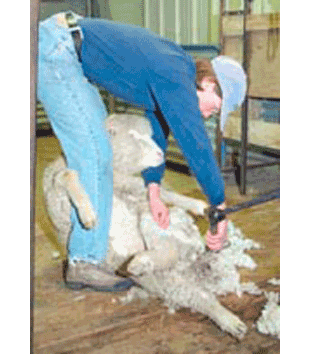
The way that wool passes from shearing to final use is long and has a few stops. It takes a lot of time to turn a fleece to a colored soft ball of yarn. Once a year and rarely twice a year sheep are brought into the cells for a shearing at accurately determined time. The second shearing is done, if possible, in order to get more wool, but wool is worse quality thereby it is not useful. Wool obtained with first shearing of lambs (not older than 8 months) is called “jarina” or “lambswool” and it is of great finesse.
Previously, the shearing was done manually and it certainly was a very tedious, time consuming work. A best shearer at the time could shear in a single day maximum of 100 sheep. Today, the shearing is done with the help of modern electric machines. Shearing is done so fleece stays closed, i.e. in one piece. Only the wool sheared from a live sheep can be labeled “pure new wool”. The goal is the finest quality of wool and the highest yield. Merino sheep annually provides 13 to 17 pounds of wool. A shearer skillfully catches a sheep so that it can not move. Only then can they shear the entire fleece from sheep in one piece. Wool from the head and legs is short and rough. The best quality is obtained by shearing it separately. One shearer today is able to shear up to 300 sheep a day. |
 |
| Sorting |
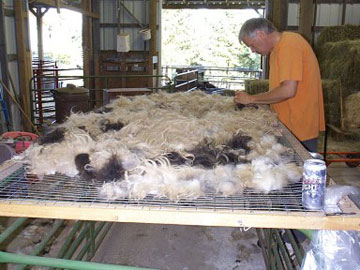
| After the shearers, people who sort wool start their work. Already with sorting of raw wool, which is today done by experienced professionals with an educated team, they consider later purpose and utility value. Every breed provides wool with specific features, and it is not regardless what kind of wool, considering its quality and fineness of fiber, is used for a knitted skirt or some other product. Experts can differ 6 qualities of fleece, and the best one is used for clothes and linen for households. Each type has its using purpose. On a large grid wool that was outside is separated of the one that was inside. This wool is full of fragments of plants and soil. Then the wool is sorted by thickness, meaning the strength of fibers. Wool is sorted by experience, the fineness, twist, fiber length, clarity, color and purpose. After sorting the wool is inserted into the boxes which are marked with various types of quality. Length and strong curling are standards of good wool. Various types of wool are curled to different degrees. Curl means greater length and the possibility of stretching. The usefulness of wool depends on the degree of twist. The less curl there is the fiber is rougher. Under microscopic magnification of 800 times, we can see the difference between sheep hair and these further findings breeders use in the classification and sorting of quality. After shearing and sorting the wool goes into the production process. |
 |
| Washing |
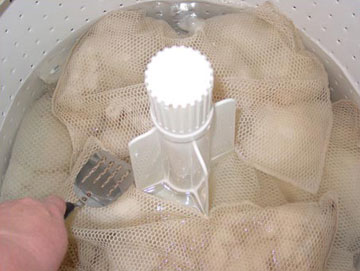
Wool is gently washed and released of grease and dirt. Before washing your wool is being shaken in special machines. Washing is done in particular huge machines, giants made of 3 to 5 containers that are filled with washing solution. Washing itself is divided into soaking, washing and rinsing. Soaking has the task of softening dirt and grease and to turn them into soap like mass. After that the washing is done. Rinsing is done in special container until the water is clean.
In cases of lanolin separation before washing, after the operation of soaking, from the container, with a special rinsing from the soap-like mass lanoline is extracted. In the case of very dirty wool, including plant remains, removal of impurities is done in two additional ways – so called carbonization and mechanical separation. Carbonization is a chemical method where wool is soaked in mild solution of sulfuric acid 4-5 0Be, and dried afterwards. In this process all the vegetable fibers become hydrolyzed, turn black, become brittle and can be removed by mechanical shaking out of wool. In this process wool remains intact, but still this method is rarely used, because the fibers lose their elasticity, the ability to roll and twist. Therefore, the cleaning of residual plant contaminants is more often done on a separate machine comber mechanically.
|
 |
| Drying |
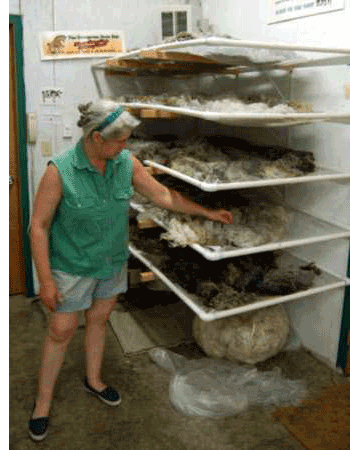
| After that, the wool is dried in special kilns. It is dried using different systems; one is by using a hot air fan Teran, water is conducted through the material and trough a drain removed from the drying rooms.
|
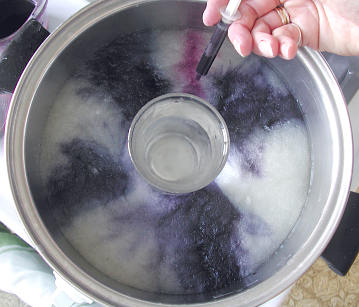 |
| Dying |
Wool is excellent for dying. Dying can be done in three ways:
- Immediately after washing, in form of flakes,
- After combing or making thread or yarn, and
- Dying the finished product, fabric, so-called routine painting.
|
 |
| Carding |
|
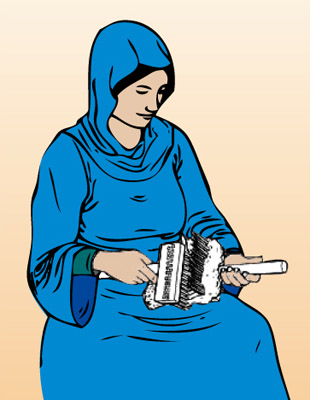
The fibers are combed to be separated from each other. Carding is used to remove short fibers, and the rest will go into processing, and additional cleaning is also performed.
|
 |
| Spinning |
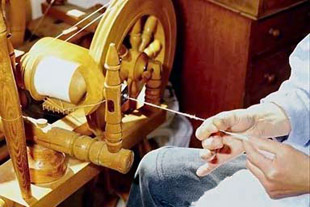
The fibers are further processed by spinning, and then fabrics are produced.
This process of processing includes:
- “Kamgarn”
Kamgarn (fabrics of combed wool) comes from long, softened fibers that are relatively parallel to each other. This procedure is the most used one. In combing room a second combing is done, fibers are linearly directed and at the end there is a fiber tie-bundle. This bundle weighting 10-30 g/m is being combed. That means, a shorter fiber material is made, with further removal of foreign particles, and the remaining mass is being simultaneously evened parallel. Then follows a series of stretching on the machines that refine the strap, while maintaining uniformity. This results in combed wool fiber that will still go to through processing depending on the product, i.e. fabric which is intended. There also could be stirring, which refines the material. At the end of this process we have the yarn, a bundle weighing 0.3 to 1.0 g/m
- “Semi Kamgarn”
This process is somewhat in between of process of obtaining kamgarn and carding. The structure of semi kamgarn yarn is in between of two other yarns. This material is usually produced for carpets, upholstery furniture, filling material and different sewing threads.
- “Strikkegarn” i.e. spinning of carded wool.
Strikkegarn is obtained from short fibers, which lie freely in various directions, in three phases:
- Opening and loosening
- Blending fibers of different origin
- Adding fat (coconut or olive oil) to enhance mechanical processing.
Such prepared material goes on a loom with rolls and breaks down into individual threads.
The fibers are directed along the length. Afterwards, follows the processing of several operations on special machines, where at the end, the material of the required fineness, with the help of the rotating spindle. In the form of the finished thread, gets wrapped around a paper cone. These yarns are recognized by their simple structure. Fiber lays smooth and parallel to the yarn. Thread is full and has a large volume.
Kamgarn is generally finer and thinner; Strikkegarn is thicker and has an attractive structure. Lighter Kamgarn is used for making clothes, blankets, so-called Blankets of artificial fur, the soft underwear, for wool for hand knitting, and stronger wool is used for tweed.
Thicker strikkegarn is used for warm coats, thicker wool for wool blankets, and lively, elastic wool for carpets. Carpets are submitted to a lot of pressure and friction, so the fibers must be very flexible, because they need to strain back quickly after they were exposed to pressure. You should also know that thanks to loosening, wool is very light. If we take two pounds of fine Merino wool, when it is expanded, you could cover a tennis court. Two pounds of wool can be spread over an area of 140 m2.
Merino wool with a label means that the fineness of the hair must not exceed thickness of 24 microns.
Coat, for example, is produced out of 4 pounds of wool.
The finest Kamgarn fabric, apparently smooth and flat, contains 60% air and only 40% fleece wool fibers.
|
|






