 Natural woolen fiber can be considered one of the oldest raw materials for making fabric. Many Cuneiform scripts just like the name of Babylon Empire, which means nothing else but "The Land of Wool", justify that. Samaritans used to wear primitively tailored woolen clothes, 4.000 BC. The oldest known woolen material has been found in Egypt. It is dated to be produced around 3500 BC. Even then woolen fabric was appreciated as a treasure and richness. It is said in Bible (27:26): the lamb will give you clothes. Natural woolen fiber can be considered one of the oldest raw materials for making fabric. Many Cuneiform scripts just like the name of Babylon Empire, which means nothing else but "The Land of Wool", justify that. Samaritans used to wear primitively tailored woolen clothes, 4.000 BC. The oldest known woolen material has been found in Egypt. It is dated to be produced around 3500 BC. Even then woolen fabric was appreciated as a treasure and richness. It is said in Bible (27:26): the lamb will give you clothes.
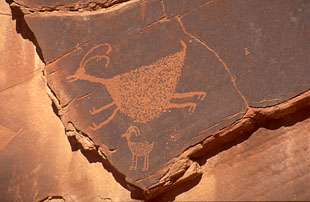 Wool is since ancient ages a material being most appreciated above all other materials, especially for knitted clothes, blankets and rugs. It has not changed much till today, though there is a wide selection of synthetic fabric for knitting and making clothes that play an important role in textile industry. Despite this, wool has not lost it's primate in the area of making clothes. As the real nature's gift, wool with its exquisite characteristics remains first choice material and its prestige has never been endangered by modern technical development. In contrary, wool becomes necessary in implementing synthetic fibers.
 |
The most important source of wool is sheep. Nevertheless, to our ancestors sheep were first a source of meat, milk and fat. The outmost importance of sheep became valuable the very moment when skillful hands have spun the first woolen thread and used them for clothes, blankets, rugs, carpets etc.
Our knowledge of wool development is pretty much shallow. We know a lot of legends, proverbs and sayings that show the importance of sheep and wool. The most widespread one is »Sleep(ing) like a lamb«, where the saying speaks about the warmness of wool and, in a different sense it means »feeling safe«.
Before New Age, the wealth of a tribe was counted by the number of their sheep. It was until the seventh century that in Mediterranean countries a sheep was the most important currency.
In Spain, the Phoenicians introduced breeding of merino sheep, and the Celts in England. In later period, the Romans develop this kind of cattle breeding, especially in today's Germany and Belgium.
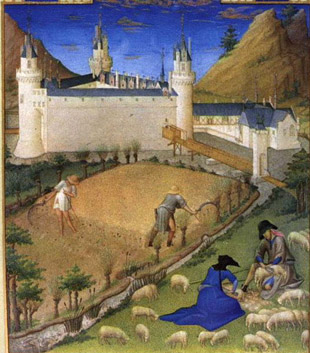 |
| In the big markets of Middle Age wool was of utmost importance. Even today the places where wool industry has begun so long ago are well known. Furthermore, the linen industry in Aachen at the end of tenth century was regulated by edict of Charlemagne. In Flanders, Lord Baldur of Flanders begins the first weaving facility in his country, which flourishes in fourteenth and fifteenth century. In England, in seventh century, wool was the most important product for trade. In 1298. Edward III gave order to his lordship's counselor to attend sessions of Upper House sitting on a woolen sack. This has become a tradition that goes on even today. |
|
|
Wool finds new trade routes because of Portuguese ships that were purchased with money from selling merino wool. Famous Italian artists and painters Giotto and Michelangelo were supposed, by their fathers' wishes, to become wool traders in Florence. At the time a wealth based on wool trade is flourishing. In the sixteenth century there were a couple of Lords' edicts that forbid exporting raw wool, so there would not be shortages for domestic use. That is the first time to introduce enforcement measures to ensure domestic market. During the Thirty Years War there was a lot of destruction so the renewal was necessary. In Prussia, Friedrich Wilhelm I bans exporting raw wool and also importing woolen products from other countries to make his subjects improve sheep breeding and wool processing in their own country. Frederick the Great continued his efforts. |
In the nineteenth century Australia rapidly develops its sheep breeding. At the end of the eighteenth century several English settlers brought a number of merino sheep from Spain, and they were very comfortable in the new continent so as soon as around 1820. Australia has about six million sheep.
Besides Australia, countries with a large number of sheep and developed wool industry include: New Zealand, Russia, Argentina, South Africa and Uruguay. Today's wool expert with long experience would be able to choose the real quality for an enterprise from the great offer in greatest wool markets. However it should be noted that due to the specific climate merino wool of Australian and New Zealand merino sheep stands out.
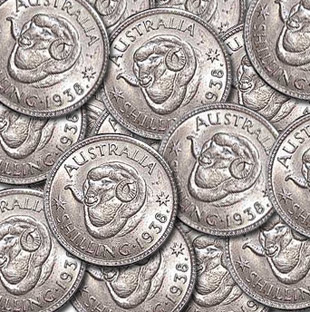 |
Australia with its wide plains provides the best conditions for sheep farming and breeding. With 170 million sheep, Australia is one of the top producers of wool. In coastal areas rich in rainfall, various cross-breeds of sheep are bred.
Grazing is so rich that one sheep is bred at four-tenths acres.
Those breeds are obtained by crossing the long-coated English »lington« sheep and South African fine fleece »merino« sheep. In addition to wool they also use meat.
Their wool is longer and rougher than in Merino sheep.
20% of the total Australian wool production is obtained from cross-breeds. These animals dislike the conditions in the Australian outback. 8 to 10 hectares of this land is needed for growing of one sheep. |
U unutrašnjosti In the Australian outback, Merino sheep that largely increase the production of Australian wool are grown. Merino sheep can stand a wide range of temperature changes from below 0 to +40°C. Australian merino sheep have wool that is especially fine and thin, which means that finer wool fabric, that is extremely soft to the touch, is produced from their wool.
Today's merino sheep provide wool 3-times heavier than 220 years ago, thanks to careful, selective breeding programs.
Their fine, soft wool is the most important export product of this country. |
|






